
Futures
Binance Futures Fees (2026): Maker, Taker, Funding and Total Trade Cost
Check the current USDⓈ-M maker and taker fees, calculate commissions on a 10,000 USDT position, and separate funding, liquidation and other costs.
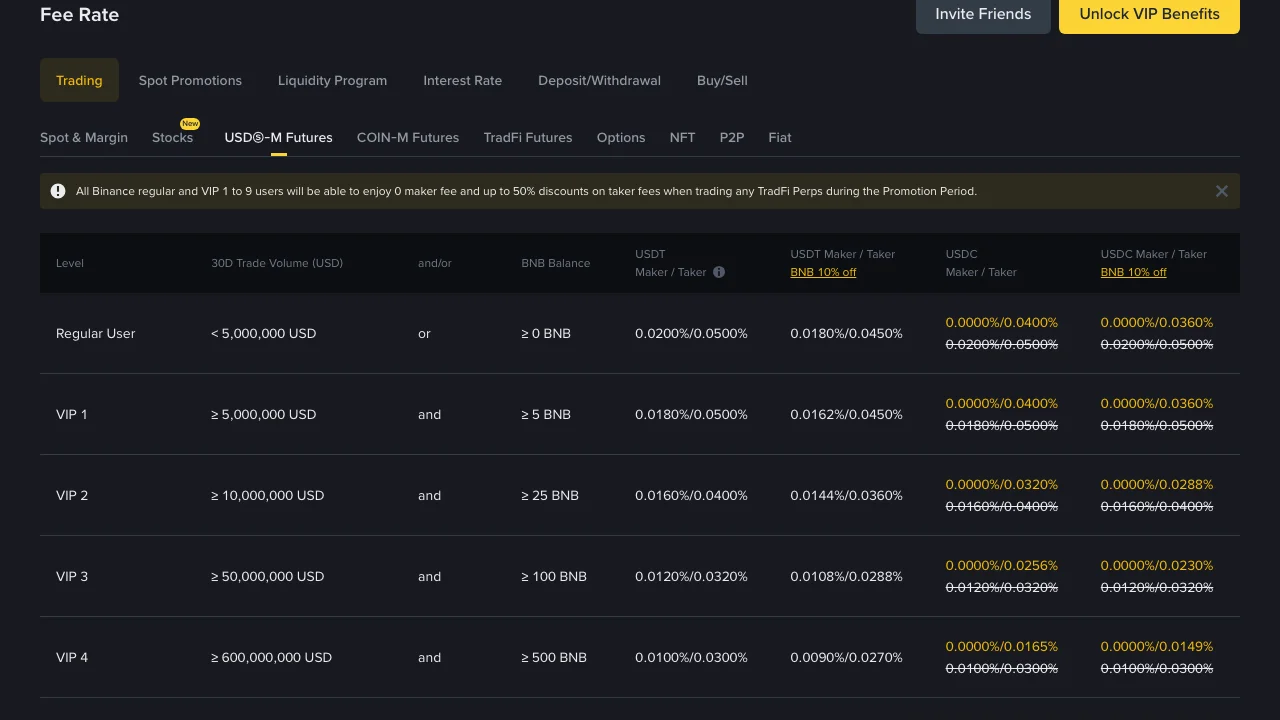
Binance USDⓈ-M futures trading fees in 2026 are charged when an order fills, based on the position's notional value, not just the margin you deposited. On the public fee table checked on 3 October 2026, the Regular User USDT rates were 0.0200% maker and 0.0500% taker. A 10,000 USDT position opened and closed as a taker would therefore incur about 10 USDT in trading commissions if both fills had the same notional value. Funding, spread, slippage and any liquidation charge are separate.
The Regular User row on the Binance USDⓈ-M Futures fee page, captured on 3 October 2026. The USDC columns show promotional figures in this capture; check the live page for current eligibility before using them.
Which rate applies to your futures order?
The fee page separates USDⓈ-M from COIN-M futures and gives each market its own maker and taker rates. A maker order adds liquidity by resting on the order book; a taker order matches existing liquidity immediately. A limit order can still be a taker if it fills as soon as it arrives. Check the execution record rather than inferring the rate from the order type.
For the Regular User USDT column shown above, maker is 0.0200% and taker is 0.0500%. The adjacent BNB-payment column shows 0.0180% and 0.0450%, a 10% reduction when that benefit applies. Binance says USDⓈ-M users need enough BNB in the Futures Wallet for the discount; otherwise the system deducts the fee in USDT. The table also has distinct USDC columns, so do not apply the USDT example automatically to a USDC contract. VIP tier, promotions and product availability can change the applicable rate. Read your own row on the live fee schedule immediately before trading.
Calculate the commission on a 10,000 USDT position
Binance's futures fee explanation gives the USDⓈ-M commission formula as notional value × fee rate. Suppose you open a 10,000 USDT notional position and later close it at the same notional value. The figures below are arithmetic examples at the Regular User USDT rates captured above, with no price movement, promotion or tier change:
| Execution | Opening commission | Closing commission | Total |
|---|---|---|---|
| Taker on both fills | 5 USDT | 5 USDT | 10 USDT |
| Maker on both fills | 2 USDT | 2 USDT | 4 USDT |
| Maker to open, taker to close | 2 USDT | 5 USDT | 7 USDT |
With an eligible BNB discount, the same two taker commissions would total a 9 USDT equivalent at the captured 0.0450% rate. The actual deduction is in BNB and depends on the conversion applied at execution. In a real trade, opening and closing notional values can differ as price changes, and each partial fill can have a different maker or taker role. Calculate each fill separately, then add the charges shown in your trade history.
Leverage changes how much margin supports a position; it does not turn a 10,000 USDT notional position into a 1,000 USDT fee base. For example, 1,000 USDT of initial margin at 10× can support 10,000 USDT of notional exposure, subject to the contract's rules. The 5 USDT taker commission in the example is 0.05% of notional but 0.5% of that assumed initial margin. Higher leverage also increases liquidation risk; it is not a fee discount.
Is funding another Binance trading fee?
No. For perpetual futures, funding is a periodic payment between long and short position holders. Binance's funding rules say it does not take a service fee from that payment. A positive rate generally means longs pay shorts; a negative rate reverses the direction. You pay or receive it only if you hold the relevant position at settlement.
The funding amount is approximately position notional at settlement × the funding rate. At an illustrative +0.01% rate, a 10,000 USDT long would pay about 1 USDT at that settlement. This is an example, not a live quote. Funding intervals can differ by contract and change in unusual conditions, so check the contract's displayed rate and next settlement countdown. For the calculation and timing details, see the Binance futures funding rate guide.
What about liquidation and other costs?
Forced liquidation can create an insurance clearance fee in addition to the trading loss. Binance's futures fee FAQ directs readers to the contract's Trading Rules for the applicable rate. Do not budget with a single fixed percentage across all contracts. A stop order may help manage risk, but it is not a guarantee of execution at a chosen price; fast markets can cause slippage or a failed limit exit.
Trading commission is also only part of the cost of entering and leaving a position. The bid–ask spread and slippage can change the effective entry or exit price. Funding can add a holding cost or a receipt. A withdrawal fee applies only if you later send assets out of Binance; it is a separate network-specific charge. If you are comparing futures with ordinary coin purchases, the Binance spot fee calculation explains that different fee table and deduction asset.
Check the amount actually charged
Before placing an order, open the live Binance fee page and choose USDⓈ-M Futures or COIN-M Futures, then read your account tier and the currency column for the contract. Check whether BNB payment is enabled and funded. For a perpetual contract, inspect the funding rate and settlement countdown as a separate item.
After execution, compare each fill's notional value, maker or taker role, commission and fee asset in Binance's order or transaction history. Then review any funding transfers separately. If a fill differs from the estimate, check the tier, promotional column, actual fill price and whether a limit order took liquidity. The maker-versus-taker explanation shows why a limit order can be charged the taker rate.
Rates and promotions can change. This article explains fee mechanics and arithmetic; it is not trading or investment advice. Use the linked Binance fee schedule and your own execution records for the amount that applies to you.