
Spot Trading
Binance Maker vs Taker Fees: Why Your Limit Order Was Charged More
Maker and taker are decided by how an order executes, not by which order type you selected. That is why a limit order can be billed at the taker rate.
Your fee tier is decided by how the order executed, not by which order type you clicked. A limit order that fills immediately against orders already sitting on the book is a taker fill, and it is billed at the taker rate.
This catches people constantly. You choose a limit order specifically to get the maker rate, the price you set is already crossable, it fills instantly, and the fee comes back higher than expected.
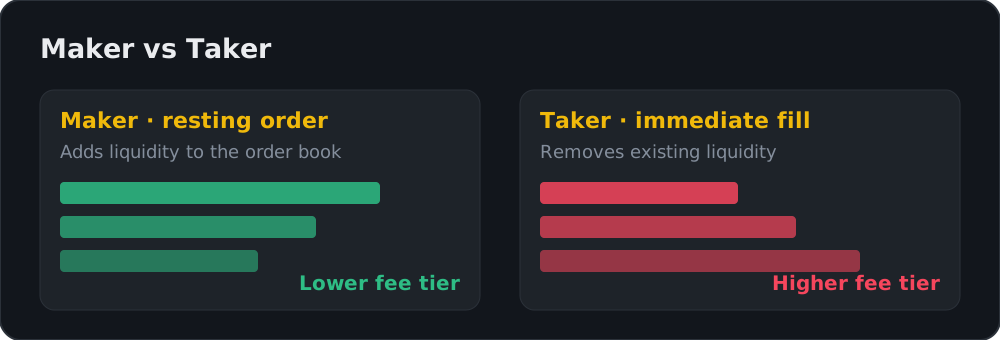
The actual definition
- Maker: your order rests on the order book and waits. It adds liquidity, because someone else can now trade against it.
- Taker: your order matches something already on the book and fills immediately. It removes liquidity.
A market order is always a taker. A limit order is a maker only if it does not cross the spread at the moment it is submitted.
If you place a buy limit at or above the current best ask, there is an existing sell order it can match right now — so it matches, and you are the taker. To rest as a maker, a buy has to sit below the best ask and a sell has to sit above the best bid.
Rates checked August 2026
| Market | Maker | Taker | Gap |
|---|---|---|---|
| Spot, VIP0 | 0.100% | 0.100% | none |
| USDⓈ-M futures, VIP0 | 0.020% | 0.050% | taker costs 2.5× |
Why maker execution saves nothing on spot at VIP0
Look at that table again. At VIP0 the spot maker and taker rates are identical at 0.10%.
So the widely repeated tip — "always use limit orders to pay less" — is simply not true for a standard spot account. There is no maker discount to capture. The columns only separate at higher VIP tiers.
On futures the gap is real and immediate: 0.02% against 0.05%. Getting maker fills on a 10,000 USDT position takes the round trip from about 10 USDT to about 4 USDT. That is where the advice originates, and on futures it is worth chasing.
The practical conclusion: on spot at VIP0, choose your order type for price control, not for fees. On futures, order type is a genuine cost decision.
Forcing maker execution with Post Only
Post Only tells the exchange to reject the order rather than let it fill as a taker. If the order would cross the spread, it is cancelled instead of executed.
That guarantees the maker rate when it fills, and guarantees you are not filled at all when the market has moved. Both outcomes are real:
- On futures, where the gap is 2.5×, the occasional rejection is usually an acceptable price.
- When you need a position closed, a rejection is a much bigger problem than a 0.03% fee difference.
Order-type behaviour including Post Only, IOC and FOK is covered in Binance Post Only, IOC and FOK.
When chasing maker fills is the wrong call
- Closing a losing position. A rejected exit can cost more in one candle than a year of fee savings.
- Thin order books. Resting at a better price may simply never fill.
- Stop-losses. A stop that must execute should not be constrained by a maker requirement — see stop-limit vs stop-market.
- Spot at VIP0. There is nothing to gain, as above.
Checking which side you landed on
After a fill, open Order History and read the fee. Divide it by executed value and compare against both columns of the schedule. If the result matches the taker rate on an order you expected to be a maker, the order crossed the spread when you submitted it.
Related reading
- The spot calculation itself: Binance spot fees
- Changing the fee asset: paying fees with BNB
- Where the maker and taker columns separate: Binance VIP fees
- Leveraged pricing on notional value: Binance futures fees
⚠️ Rates were checked in August 2026 and vary by tier, market, promotion and region. Confirm live rates in your account. Not investment advice.